
Why Healing Feels Strong — or Doesn’t
Healing Isn’t Just About Time
We often talk about healing as if it’s a countdown: six weeks, three months, six months. But the body doesn’t heal by the calendar. It heals by rebuilding structure.
When a tendon or ligament is reattached to bone, strength does not come from the stitch or the anchor itself. It comes from how well the body can recreate the natural attachment between soft tissue and bone, a process that has been well described in orthopedic and sports medicine research.
If that connection matures properly, the repair begins to feel solid.
If it doesn’t, the tissue may be “healed” on paper, but never fully trusted in real life.
Two Repairs. Same Surgery. Very Different Outcomes.
Two patients can undergo the same tendon or ligament repair.
They follow the same rehabilitation plan.
They wait the same amount of time.
Yet one returns to activity with confidence, while the other hesitates, unsure whether the repair will hold.
The difference usually isn’t effort or motivation.
And it isn’t just pain tolerance.
It’s what happened, or didn’t happen, at the microscopic connection between tendon and bone.
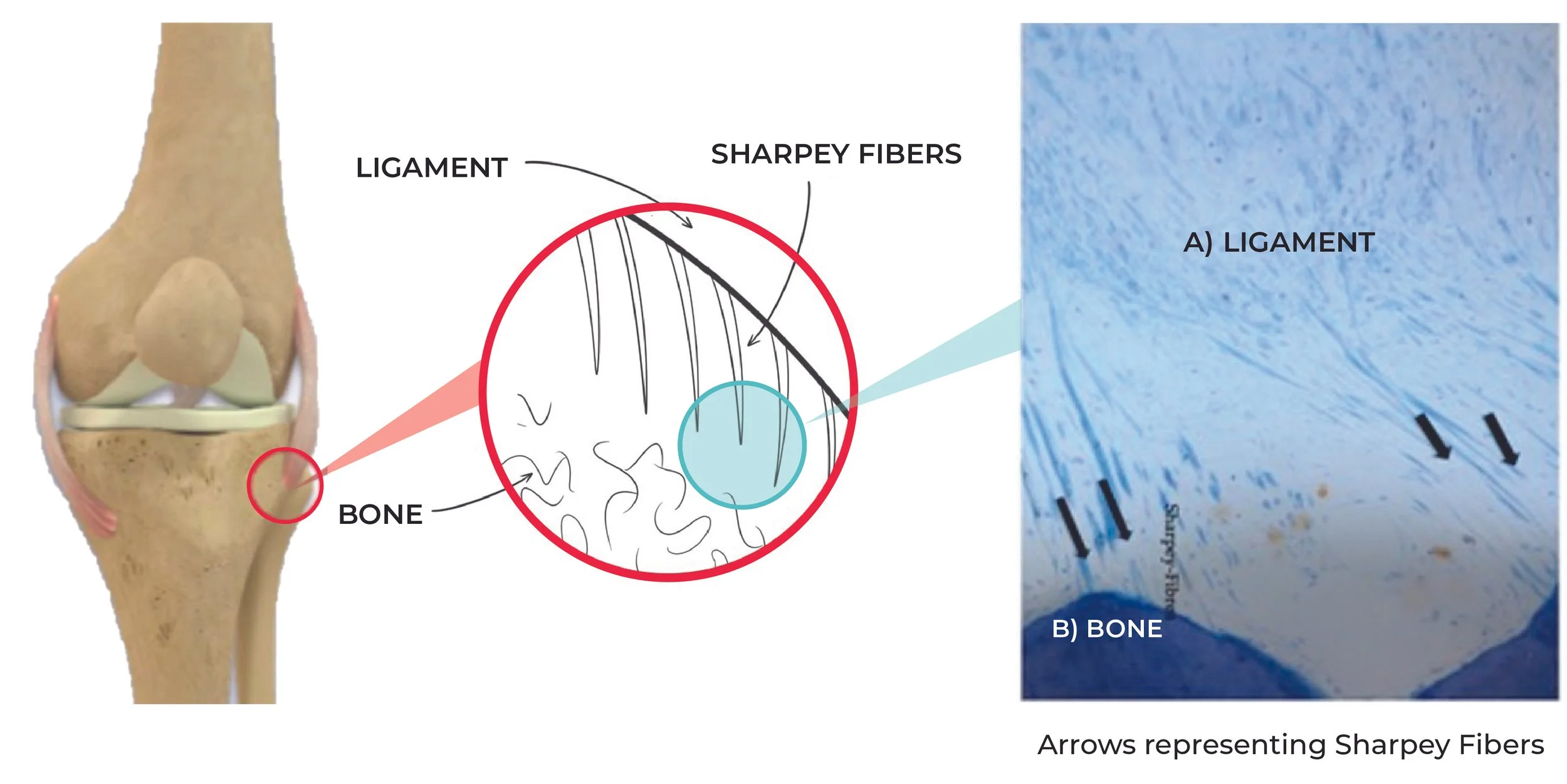
Figure 1: Sharpey’s Fibers. Structure of Sharpey’s Fibers (arrows), bridging the connection from the ligament (a) to bone (b).
The Real Work of Healing Happens at the Interface
Where tendon meets bone, the body rebuilds strength through tiny collagen fibers that grow from soft tissue directly into bone. These fibers, called Sharpey’s fibers, act like natural anchors, transferring force safely from muscle to skeleton.
Sharpey’s fibers ultimately allow repaired tissue to tolerate daily loads such as gripping, pushing off, or changing direction.
The Fragile Window Most People Never See
In the early weeks after surgery, Sharpey’s fibers are just beginning to form. At this stage, they are biologically immature and mechanically weak, which is why early healing depends so heavily on fixation stability.
Research has shown that micromotion, gaps between tissue and bone, or bone trauma during this phase can interfere with fiber formation and delay the return of real strength.
This is often where outcomes quietly diverge.
Why This Matters More Than Ever
Today, more people remain active later in life. Expectations have changed. Patients don’t just want pain relief; they want to trust their repair when they return to movement.
At the same time, many tendon and ligament repairs occur in small, delicate bones of the hand, wrist, foot, and ankle, where bone preservation and biological healing are especially important.
In these settings, fixation isn’t just about strength on day one. It’s about creating the right conditions for biology to do its job.
Why Some Repairs Never Feel Fully Reliable
Many traditional fixation methods were designed primarily to “hold” tissue in place. While they can provide initial stability, they may also introduce challenges that matter at the biological level:
Larger drill holes that remove valuable bone
Implant bulk that creates small gaps at the tendon–bone interface
Micromotion during early healing
In some cases, implant migration or bone loss that may require revision surgery
Biomechanical studies in small bones have demonstrated that fixation performance can vary
significantly depending on anchor design and bone quality, factors that directly influence
healing at the interface.
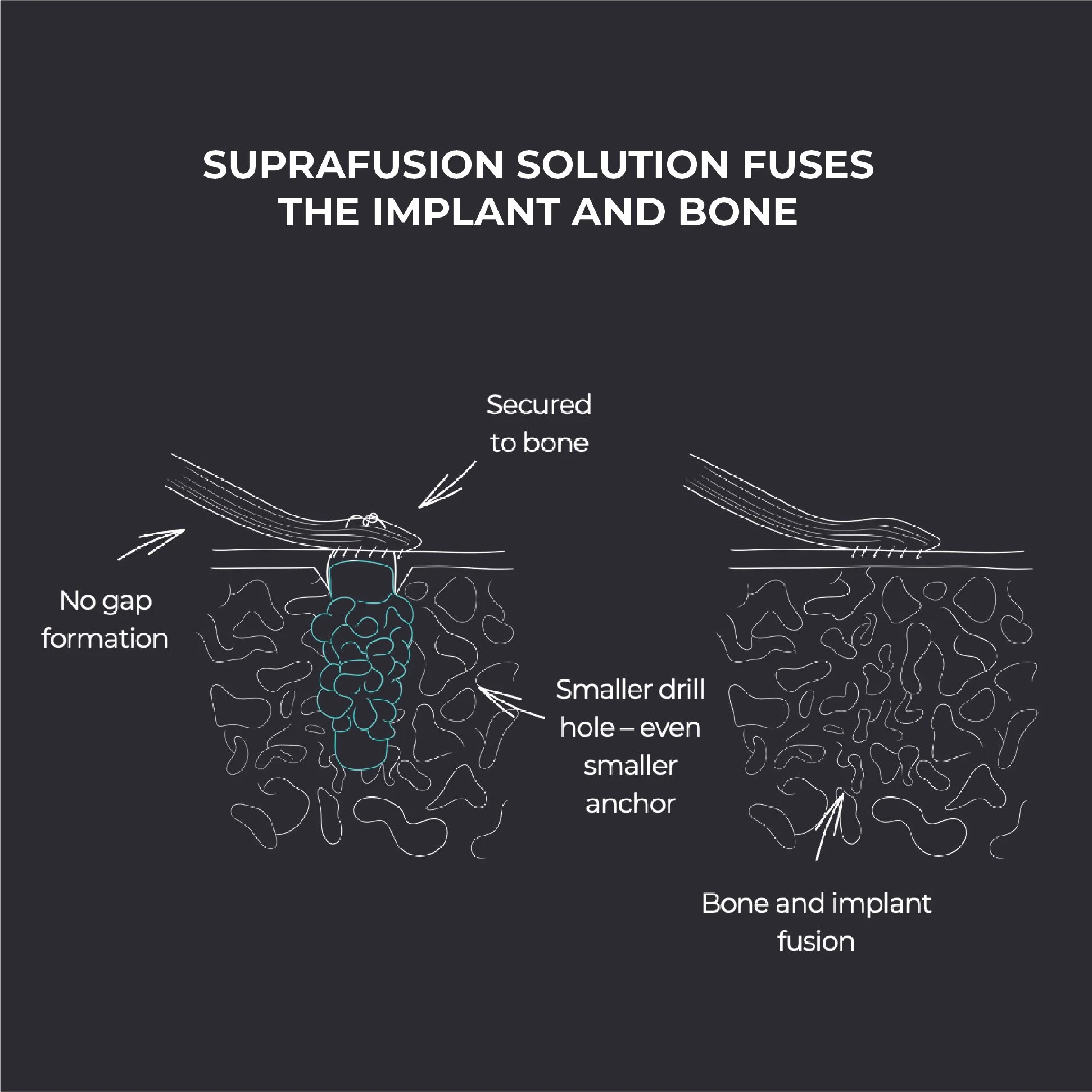
Figure 2: SF Push-in Anchors Are Engineered To Work In Harmony With Bone Physiology. SF Push-in Anchors secure ligaments tightly to bone, preventing gap formation and enabling intimate contact that supports optimal healing. Using ultrasound-driven fixation, the anchor integrates directly into the bone structure, allowing for a smaller drill hole and an even smaller anchor while achieving superior fixation strength. In addition, SF Push-in Anchors are fully bioresorbable, promoting anchor–bone fusion and eliminating the need for revision surgery.
Fixation That Respects Biology: SupraFusion Technology
SupraFusion Technology was developed with this biological reality in mind.
Rather than relying on oversized hardware or compression alone, SupraFusion Technology uses ultrasonic energy to integrate a bioresorbable anchor directly into bone. This approach is designed to:
Maintain tight, gap-free contact between the tendon or ligament and the bone
Use a smaller footprint, preserving bone
Provide immediate stability during the most fragile healing phase
Resorb over time, avoiding the need for anchor removal
Pre-clinical histology and clinical outcome studies in small-bone applications have shown stable fixation, a healthy bone response, and fast and reliable functional recovery, supporting the biological environment required for Sharpey’s fibers to mature.
Importantly, the technology is designed not to overpower biology, but to stay out of its way.
Why Some Repairs Feel Strong
Strong healing isn’t forced.
It’s grown, fiber by fiber, under the right conditions.
When fixation protects early biology instead of disrupting it, Sharpey’s fibers can mature as intended. And when that happens, patients don’t just return to activity; they return with confidence.
Discover how SupraFusion Technology aligns fixation with natural healing biology: www.supra-fusion.com
References
Langhoff JD, Kuemmerle JM, Mayer J, et al. An ultrasound assisted anchoring technique for fixation of implants to bone – a histological pilot study in sheep. Open Orthop J. 2009;3:40–47.
Heidenreich D, Langhoff JD, von Rechenberg B, et al. The use of ultrasound-assisted bioresorbable implants in bone: biocompatibility and anchorage. Eur Spine J. 2011;20:1821–1836.